

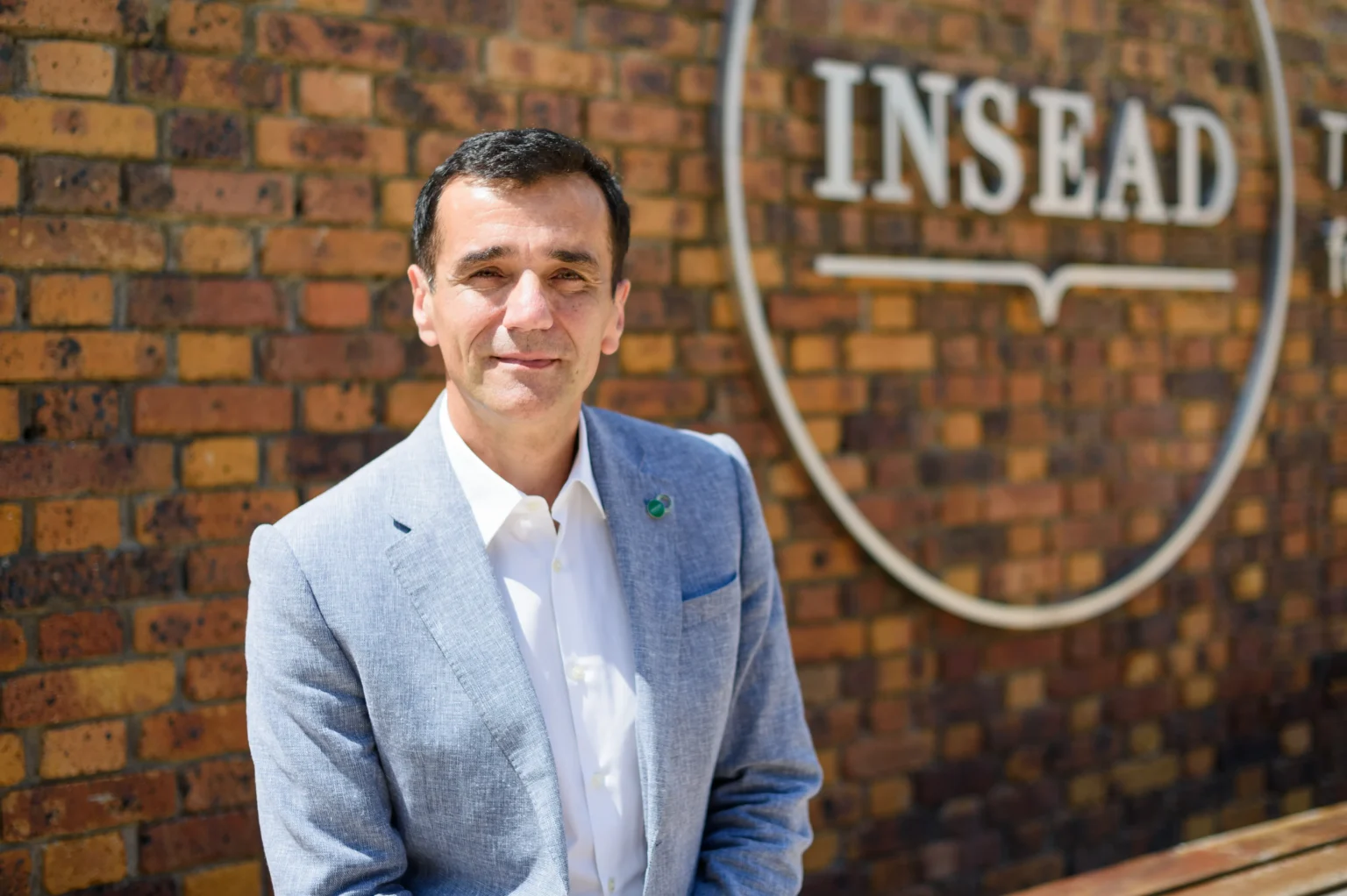
In his opening remarks at the Neumorimite forum, Professor Ilian Mihov linked economic growth to the quality of institutions, education, and Bulgaria’s ability to work with its people around the world.
Bulgaria has room to grow faster than developed economies. That was the good news in Professor Ilian Mihov’s remarks. The bad news: catching up does not continue on its own.
The macroeconomist and longtime professor at INSEAD placed the discussion in a broader context. Poorer countries can advance quickly when they adopt existing technologies and production models. At some point, this source of growth weakens. Then the quality of institutions and human capital begins to determine how far a country can go.
“We have reached a point beyond which we will not be able to grow faster with institutions like these,” Professor Mihov said of Bulgaria.
He presented World Bank data on government effectiveness, the rule of law, regulations, political stability, and control of corruption. In his reading, Bulgaria has increased its incomes since the late 1990s, but the quality of its institutions has not improved at the same pace.
This is not a verdict. Rather, it is a limit that must be recognized in time. Countries can increase their incomes for a while even without deep institutional change. Then comes the middle-income trap: the old model is no longer enough, and the new one has yet to be built.
Education Works Over the Long Term
The effects of education are rarely visible within a single political term. Professor Mihov drew attention to the link between students’ performance and economic growth over the following decades.
In the charts he presented, Bulgaria lags behind in reading, mathematics, and science. He warned that today’s results will determine the country’s opportunities in 20, 30, or 40 years. The next few years may not show a dramatic change. The long term will reveal it.
This logic applies to higher education and management education as well. An economy with higher productivity needs people who can lead complex organizations, work with new technologies, and create knowledge.
What He Saw in Singapore
Professor Mihov has lived and worked in Singapore for years and has served on the board of the Economic Development Board. From that experience, he drew two examples that he considers useful for the discussion in Bulgaria.
The first is the Economic Development Board itself. It is part of the state system but includes representatives from business and academia. It discusses strategic priorities and works beyond the term of a single government.
The second is the continuous training of people in the public sector. According to him, employees and managers in Singapore take part in management programs to develop skills in strategy, communication, and leadership. INSEAD has also worked on such programs with Singaporean institutions.
This is not a ready-made model to import. Bulgaria has a different political and social context. But the principle is clear: institutions do not improve on their own. Someone must deliberately develop the people within them and create a sustained dialogue between the state, business, and academia.
People Abroad Are Not a Lost Resource
Finally, Professor Mihov returned to the reason he was taking part in NEUMORIMITE. Bulgarians who have studied and worked around the world are often portrayed in public debate as a loss for the country. He offered another interpretation: they are an investment that Bulgaria has yet to make full use of.
The question here is not whether everyone should return. Mihov himself emphasized that the idea is for people abroad to work together with educators and organizations in Bulgaria. In this way, their knowledge, contacts, and experience can become part of courses, research, and leadership programs.
“The willingness is there. What’s missing, however, is this network,” Professor Mihov said.
This is precisely where NEUMORIMITE can play a role: finding the people, connecting them with a specific need, and following up on what happens after the first meeting. Otherwise, good intentions remain just intentions.